A detailed well executed due diligence is a necessary pre-requisite for a well-planned acquisition. This however, is just one part of the equation. There are several others, the confluence of which should fall in sync in order for those identified synergies to come to fruition.

M&A practices and procedures have evolved over the years and it is often the case that electronic data rooms provide plethora of information & transparency. Secure content management, collaboration solutions enable exchange, control, and management of information between organizations through their virtual data room and deal space solutions. Remember, the acquisition process is intended to be rapid, smooth and yet detailed, all encompassing and onerous.
The Internal Control standards (SOX) ushered in era of new requirements for governance and conduct to public company boards, CFOs and CEOs requiring certifications, reporting requirements and non-compliance penalties. The Committee of Sponsoring Organizations of the Treadway Commission (COSO) requirements has further asserted the top-down risk based approach. The pervasive need for controls has caused the M&A due diligence to get more in-depth, deeper dives in to financial reporting issues, verifiability and validation. Large M&A transactions attract government enforcement and regulatory requirements and public scrutiny. However, I have limited my attempt to providing some insight in to how due diligence is both an art and a science that follows a certain steps or processes. Due diligence is getting increasingly creative and strategic, given that most M&A deals have a strategic intent.
The thought of M&A due diligence often times conjures up formal review of key contracts, representations, warranties (rep wars) and such corporate documents. However, it should go deeper than that in to the values, culture, history, mission and intangible assets of the company. As a valuation consultant, I recently witnessed how a business was forced to write down millions of dollars from their Balance Sheet barely about a couple years after post-closing, as the metrics that were assumed at the time of acquisition simply were not visible in the first quadrant, instead some of the strategic costs advantages were anything but. M&A process involves some serious hours of work from lawyers, accountants, investment bankers, industry specialists and strategy consultants – depending on the size of the deal, complexity and wherewithal of the entities involved.
Due diligence should be a realistic test to assess whether the underlying assumptions driving the deal to both parties are reasonable or illusory. Cross-border acquisitions in the global M&A marketplace heightens the need for the buyer to perform a proper regulatory due diligence.
The due diligence work is two fold: financial – analyzing strategic costs – ‘As Is’ and ‘To be’ states, factoring in transaction costs, value accretion and myriad other relevant financial metrics and strategic intents – generally a futuristic state on how the acquirer may benefit by the transaction, which should dovetail with the long term vision of the enterprise. In economic terms, these could be anything from economies of scale to a global footprint with access to newer and enlarged markets with immense growth possibilities and synergies. Management Accountants play a critical part in analyzing and articulating whether or not the proposed transaction is viable. The M&A transactions should focus on pitfalls that could push post-closing metrics with negative trend lines to the top of the heap.
A few quick pointers to the process:
1. Include broad rep-wars and liability holdbacks, and indemnifications in the purchase agreement.
2. The seller negotiates for carve-outs – limiting liabilities before the buyer may seek reimbursement for undisclosed or unexpected liabilities.
3. A rational approach would be not to get too involved in minutiae instead focus on the big picture. The key is to confirm factual assumptions and enterprise valuation underlying the terms based on which the buyer negotiates the deal. If the risks and liabilities outstrip the perceived benefits of the transactions, it is worthwhile to walk away from it all.
4. Ask the right questions at the appropriate time and to create trust and urgency in the seller to make full disclosures.
5. Prepare comprehensive and customized checklists of the specific questions, maintain methodical system for organizing and analyzing the documents and data provided by the seller, and quantitatively assess the risks raised by those problems discovered in the process.
6. What are the obligations that the buyer would be required to assume post-closing – stock purchase; asset purchase: define liabilities assumed and identify few successor liabilities that cannot be contractually avoided: for e.g.; leases.
7. Third-party / regulatory agencies approval requirements.
8. Financial: incremental cost of debt, equity dilution, current market cap versus implied valuation post-closing.
9. Due diligence is neither a hasty one to save costs / appease the seller, nor is it a tedious fishing exercise.
SAGEVIEW Valuations & CFO Advisory Services has resources to provide such CFO Advisory Services. Please e-mail or contact at the number indicated below for a preliminary discussion to assess your needs.
All rights reserved. This publication belongs to SAGEVIEW Valuations & CFOA Services. No part of it may be reproduced, copied or distributed without the prior written permission of the publisher.
Imagine you are the owner of a company with $5Million in sales. It has been operating for a number of years, and is profitable, but you want to grow the business.
Say you would like to double sales over the next five years. Before you start the growth process, you should ask yourself: Why double sales? What will a doubling in sales mean to profits and overall health of the business? What cash is needed to double sales? Quite often, you know that you are profitable but are not satisfied with the level of profits and you do not know exactly why profits are where they are or what should be done to increase them.
Is transaction processing good enough to support your growth plans? An Accountant records daily transactions and prepares monthly financial statements, but he does not give the owner the guidance as to how to double profits over the next five years. A doubling of profits will take the business to the next level and involves a number of different steps. You need a key financial person to help you develop them. A Part-time CFO (Chief Financial Officer) also called Fractional CFO is that person.
Customers care for four critical metrics: Value for money, on-time order delivery, quality, and responsiveness. A CFO can help you:
- Measure what matters to customers,
- Forge essential partnerships, and
- Promote an enterprise view.
A Fractional CFO can raise questions around operational performance. By emphasizing metrics such as perfect order delivery (On-time, complete, error-free), perfect response to inquiries and complaints (first-time-right, complete, error-free), and variance to promise date for new product or service introduction, the key financial person can raise thought-provoking questions that strike operational performance and where the resolution of problems demands cross-departmental collaboration.
When customers receive error-free orders and responses to inquiries that are right the first time, they not only pay invoices faster (keeping DSO on target), but this also helps increase customer loyalty and build revenues.
A key financial person can help communicate plans to transform the business in financial terms that are easily understood and make a case for change. This helps forge essential partnerships across your business.
A CFO can help provide a narrative of what your business wants to accomplish, taking into account performance for customers, key business processes, and the technology that enables performance. This means asking questions about current and desired level of performance needed to create customer value. A CFO can help your leadership team towards a shared understanding of the scope of the organizational challenge and need for collaboration.
A simple schematic representation would be:

In addition, there are more reasons than the above, in deciding to hire a ‘part-time’ / ‘as needed basis CFO’ for your business. A fractional CFO can help in:
- Ensuring business decisions are grounded in solid financial criteria;
- Providing insight and analysis to support you the business owner and your senior managers;
- Help lead key initiatives in finance that support your overall strategic goals;
- Help find funding, enabling and executing strategy set by you the business owner;
- Help you in developing and defining the overall strategy for your organization; and
- Represent your organization’s progress on strategic goals to your bankers, investors and external stakeholders.
A CFO can leverage that financial discipline, by a stronger understanding of how a particular strategy and its value drivers contribute to value creation. An experienced financial professional can provide timely inputs and solutions in operations and operational finance; be a performance leader, with experience in business transformation and business analytics; and a growth champion, characterized by significant experience in mergers and acquisitions, external networks, independent thinking, and strategic insight.
Other important reasons as to why business owners desirous of growing their business need to redesign their business strategies is the fact that industries transform fundamentally because of nonlinear shifts – for example; there could be technical discontinuities – i.e.; digital technologies, which are fundamentally transforming media, entertainment, and music industries. Also, customers of the future could be fundamentally different from customers of the present, demanding fundamentally new business models. There could also be nontraditional competitors depending on the industry in which your business operates.
A CFO can help identify and mange these strategic risks. Identifying and mitigating risk from a portfolio perspective is often complicated and resource intensive. What you as a business owner need is an able business adviser who will better identify and measure risk factors. A CFO looks for obstacles and opportunities, and ways to overcome and capitalize on them. Are there any unforeseen risks? Are there any new insurance requirements? Are there any new legislation or competitive threats? Will you need financing? Are there acquisition opportunities? How do you evaluate and finance them?
Also, business owner can get informed through executive dashboard or a set of dash- boards. Some of the valuable information that a CFO can provide through dashboard reporting is:
Types of indicators
- Nonfinancial metrics
- Financial indicators
- Qualitative descriptions
Risk Categories
- Strategic
- Operational
- Compliance & legal
- Reporting
- Credit (e.g. asset recovery)
- Market
- Environmental
- Sociopolitical – workforce issues etc.
- Technical – e.g.; innovations. IT
As an owner manager wanting to grow your business, one of the biggest challenges you might face could be when implementing a new information technology system. An inadequate or incorrect definition of the need for the system prior to buying it externally or developing it internally can limit the ability to provide effective oversight over business operations. A CFO can define early the purpose in concise finance terms and help identity metrics that will further help in tracking the health of your business as you embark on your growth plans. The intent is to provide accurate metrics based on unbiased information inputs that can help you as a decision maker.
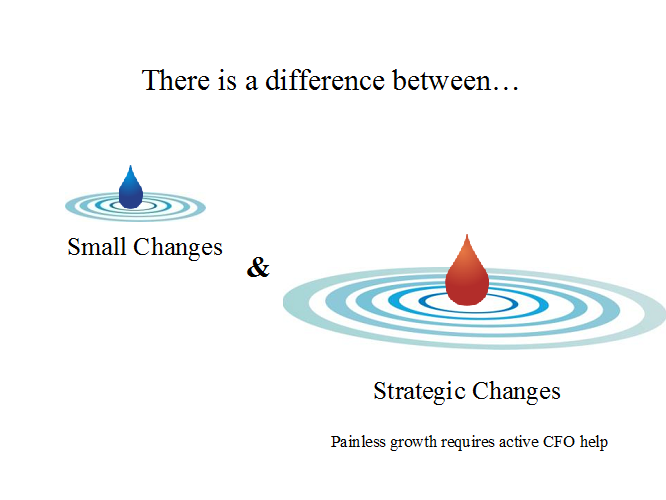
While there are many reasons to hire a CFO, we are presenting three compelling reasons why you should consider hiring one.
A CFO drives the numbers instead of recording the numbers. A CFO can help determine what is driving the current sales and profits, analyze where future sales and profit growth will come from. For example, a company may often receive 60% to 80% of its profits from 20% to 40% of its customers or product lines. While it is easy to determine the extent of customer concentration or product line portfolio, determining just how profitable a certain customer or product line is not always straightforward.
For example, many businesses and companies use broad strategic approaches for estimating cash flows that are not closely tied to detailed tactical assumptions about future operations. These forecasts may not be reliable because cash flow projections of new products can have a 30% to 40% margin of error.
The Activity Based Costing (ABC) model with benchmarking can forecast business processes, activities, revenues, operating costs, and capital costs. The ABC for capital budgeting analysis is an example of activity-based management (ABM), which provides economic information for management decision-making. Such complex analysis needs involvement and guidance from a CFO level professional.

Thus a CFO will ascertain how costs will change once production reaches a new level. E.g.; how many new staff will have to be hired and whether there will have to be capital expenditures and / or acquisitions. In order to increase sales, a company may need to increase staffing and maintain it at a higher level in order to achieve higher committed levels of sales. Barring increased productivity of labour, this can mean higher labour unit costs. Therefore, what business improvement processes must be implemented and what productivity enhancing capital expenditures will have to be made requires critical analysis and thinking by a CFO level business advisor.
Finally, a CFO can develop key performance indicators (KPIs) to measure the progress of the business. A key performance indicator measures a company’s success in a particular activity that is of importance to you as a business owner. E.g.; percentage of customers retained in a period. If a company has sufficient analytical support in determining what drives profit growth, these indicators need to be constantly measured and monitored.
A CFO is a key support person or ‘wingman’ to the business owner. There are numerous important matters to deal with as the company grows such as the implementation of effective internal controls, structure and procedures, the hiring and development of staff, and the creation of effective tax strategies. For example, are you the business owner that ultimately going to sell the company? A CFO would be the person you turn to discuss that option.
Engage a CFO sooner than later. A contract or part-time CFO allows you to integrate a senior level executive into your organization without the price tag and commitment of a full time CFO.
An aspiring business owner can find an able partner in a transformational CFO who can help build the right performance-based culture. In the end, results are what matter, yet the journey may be as important as the destination.
SAGEVIEW Valuations & CFO Advisory Services has resources to provide such CFO Advisory Services. Please e-mail or contact at the number indicated below for a preliminary discussion to assess your needs.
All rights reserved. This publication belongs to SAGEVIEW Valuations & CFOA Services. No part of it may be reproduced, copied or distributed without the prior written permission of the publisher.